


Anyone who lives with a greyhound soon discovers that their way of moving, resting, and expressing themselves is special. They are elegant, sensitive, and very expressive dogs, but precisely for that reason, it can sometimes be difficult to interpret their postures correctly. Many people see certain positions and don't know if they are part of normal behavior or a sign of discomfort. Understanding the greyhound body language It is essential to take better care of them.
A greyhound can stretch out in a very conspicuous way, remain still with apparent calm, or display subtle gestures that go unnoticed by those unfamiliar with them. Knowing how to distinguish between a comfortable posture, a sign of stress, or an expression of pain helps you act sooner and build a much more attentive and respectful relationship.
Greyhounds don't always express discomfort openly. They are often discreet dogs, especially if they have experienced difficult situations or are learning to trust. That's why the greyhound body language It should not be interpreted hastily or with generic ideas applied to any dog.
Reading their signals correctly helps to:
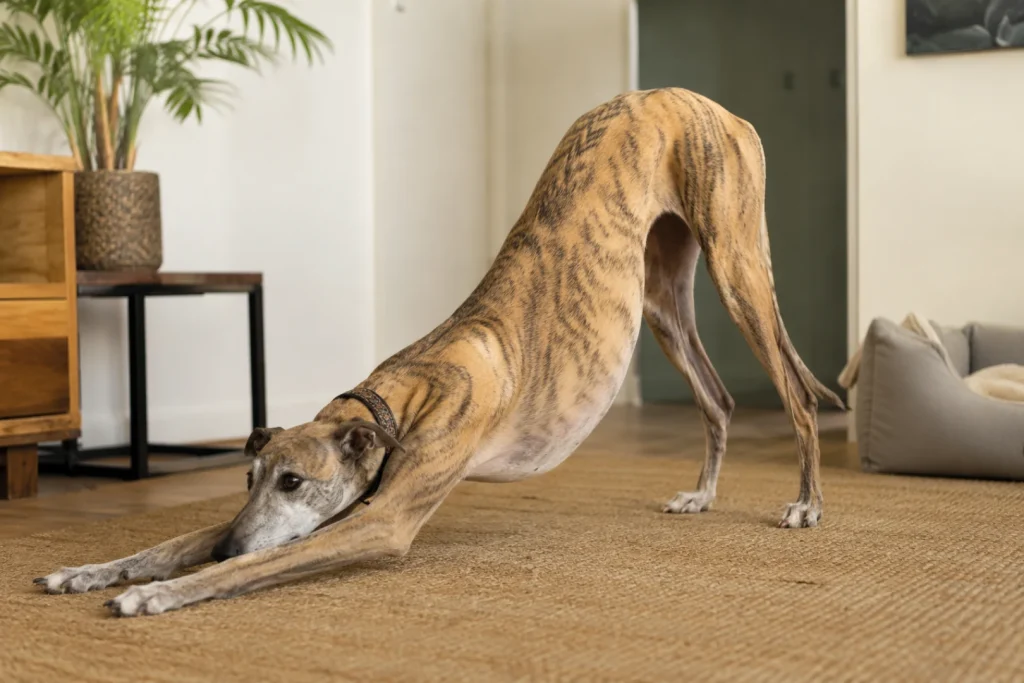
One of the most common postures in greyhounds is this deep stretch of the front legs, sometimes accompanied by raised hips and a relaxed expression. In many cases, it's part of their normal repertoire when getting up, becoming active, or preparing to move.
If it appears in normal contexts, with a relaxed attitude, good mood and fluid mobility, it is usually simply a natural way of stretching or lengthening muscles.
The problem is that some physical signs closely resemble normal behaviors. In those cases, it's important to look at the whole picture.
When a dog seems to stretch a lot but then walks strangely, hesitates when moving, or shows stiffness, there may be a physical discomfort behind it.
If the body is low, the tail is tucked up, the ears are back, or the dog avoids contact, it may not be a relaxed posture, but a sign of stress.
A noticeable change in posture, rest, way of getting up, or desire to move deserves attention.
Within the greyhound body language, Some common signs of stress or insecurity are:
These signs do not always indicate intense fear, but they do usually show that the dog is not entirely comfortable with the situation.
When there is pain or physical discomfort, indicators such as the following may appear:
A posture upon waking is not the same as one during a walk, a visit to the vet, or a moment of interaction with strangers.
Don't just focus on one specific posture. Tail, eyes, breathing, ears, and movement all provide a lot of information.
Every greyhound has its own unique characteristics. The better you understand its usual behavior, the sooner you'll detect anything out of the ordinary.
If the signs persist, pain is suspected, or the dog shows persistent fear, it's advisable to consult a professional. Sometimes a physical cause needs to be ruled out; other times, the focus will be on the dog's emotional well-being.
Understanding the greyhound body language It's a way to better care for these sensitive and special dogs. A "yoga stretch" might just be normal behavior, but it can also resemble signs of stress or pain if we don't look at the bigger picture.
Looking more closely, interpreting calmly, and understanding the context allows you to better respond to their needs. Because listening to a greyhound isn't just about hearing them, but about learning to read everything their body is saying.